Digital communication will have undergone a massive transformation by 2026. And we have officially entered an era of hyper-personalization powered by artificial intelligence. Consumers expect deeply relevant messaging tailored specifically to their behaviors and preferences. Forget about traditional batch-and-blast newsletters; instead, very smart, intelligent systems analyze zero-party data to come up with personalized campaigns.
Therefore, this rapid development leads to a clear dilemma for current marketers and sales professionals. Besides relying completely on algorithms, which can make your brand feel cold and robotic, you still need to keep in mind the genuine authenticity of a human-written message. On the other hand, if you totally stick to manual outreach, you will be limiting your potential for growth and revenue.
This article presents the advantages of both manual and automated communication approaches. In addition to that, we walk you through a step-by-step guide on automating emails with modern tools and give you actionable tips for creating a hybrid workflow. You can have the best of both worlds by using technology along with the personal touch, which leads to maximizing conversions and building lasting relationships.
The State of Email Marketing in 2026
Nowadays, the email marketing ecosystem is heavily dependent on zero-party data and AI-hybrid marketing teams. In return for enhanced experiences, customers willingly share their preferences, thus giving brands the exact information that is required for tailoring their messages. Content marketers nowadays are directly working with AI assistants to write content, analyze data, and run campaigns more quickly than ever.
Nevertheless, with such a very large capability, organizations are still challenged by the fact that inboxes are so packed with messages that users may not find the time to read them all. Achieving inbox placement, getting high open rates, and maintaining good engagement takes careful and thorough work following all the set rules of spam filters and authentication methods. Also, spamming and sending bulk unrelated messages will still trigger spam filters, which will wall off the sender immediately.
Clearly, the financial return on investment is in favor of strategic targeting. Recently published figures by the industry demonstrate that highly targeted, segmented campaigns significantly outperform generic broadcasts, contributing to an average ROI of $36 to $40 for every dollar spent. For business survival, sending the right message to the right person, the brand can no longer be ignored.
The Rise of Email Automation: Benefits and Best Practices
The idea of modern email automation goes way beyond basic autoresponders of the old days. Present-day systems are based on highly intricate, stimulus-response workflows that instantly react to certain user actions, e.g., if a potential customer not just looks at a price page but keeps doing that or downloads a certain whitepaper.
The provision of the same level of service to all leads at the same time ensures that even during busy periods or times when there is a staff shortage, your prospects will not be neglected. This is where consistent, timely follow-ups come in through automated platforms without ever needing any manual input from your people.
Continuous testing and improvement play a big role here because that is the only way you can maintain an effective flow of automated communication. Dynamic content blocks that alter according to a recipient’s region, previous purchases, or even stated preferences should be used to great effect. Besides that, continuous A/B testing needs to be carried out on subject lines, send times, and body copy so that your sequences perform at their peak.
The Case for Manual Emailing: When the Personal Touch Matters
Although AI has taken automation to a whole new level, the complete elimination of human involvement is still not the right answer to every business communication scenario. It is to be noted that algorithms are really incapable of demonstrating the empathetic nuances and the deep understanding of human nature necessary during complex dialogues. The only way sometimes is to put hands on the keyboard and write a custom message that really moves a conversation forward effectively.
It is the same inclination towards manual messaging that works when the stakes are rather high. For one thing, after a procurement decision on high-priced B2B products or services is typically very unique in nature, executives need to be able to come up with organized solutions that are in line with the organizational goals of those clients, something that a generic template can hardly fulfill.
In addition, prioritizing personalization in your outreach is a sure way to build trust with the recipients. They will be much more inclined to respond if they realize that a person has actually taken time to understand their individual circumstances. To be able to do this critical task consistently, you can rely on ultimate time-blocking apps to allocate specific hours only for high-value manual outreach.
How to Automate Emails Effectively: Tools and Strategies
Learning exactly how to automate emails effectively is the key to scaling your business without sounding like a robot. However, the journey starts with collecting accurate and clean zero-party data directly from your target group through quizzes, preference centers, and onboarding surveys. Afterwards, the data can be used for audience segmentation, deciding based on users’ interests and behaviors.
| Platform Type | Best Use Case | Key 2026 Features |
|---|---|---|
| HubSpot | Comprehensive inbound marketing and CRM | Advanced behavioral triggers, AI content drafting |
| ActiveCampaign | Complex logic and deep segmentation | Predictive sending, visual automation mapping |
| AI-Native Platforms | Teams needing heavy generative assistance | Hyper-personalization, automated list hygiene |
For a critical part of your success, selecting the right software is paramount. Currently, there are a number of very powerful tools in the market that are being heavily used by many to not only streamline their messaging but also to keep the personalization very deep.
In order to make your automated messages appear more natural than intrusive, you want to employ the behavioral triggers whereby the message delivery time corresponds exactly to the prospect’s need. Not only that, you anticipate their needs, which will make your automation quite helpful.
The Hybrid Approach: Combining Automation and Personalization
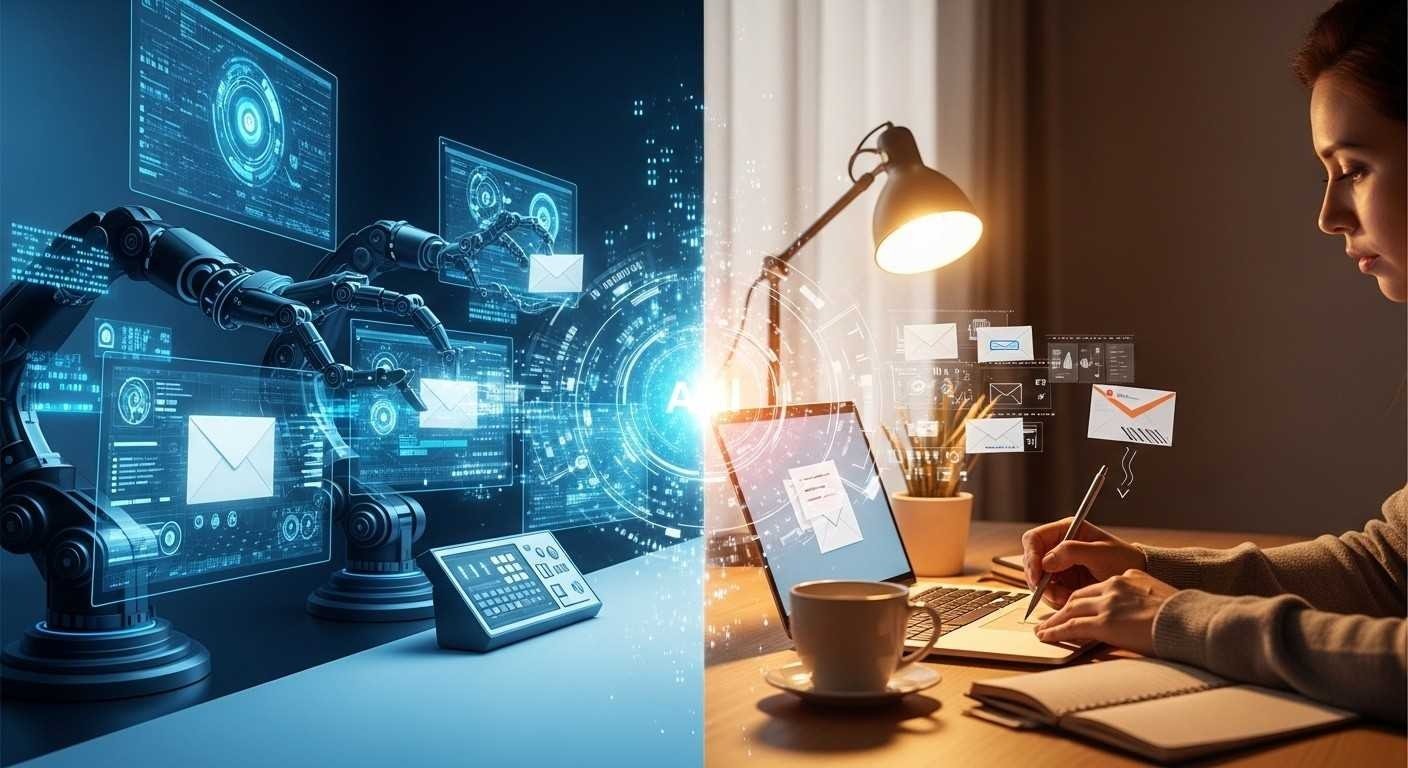
The “human + AI” hybrid model is undoubtedly the only answer for medium- to large-scale operations. It is mainly this approach that exploits the benefits of both to formulate a communication funnel that is virtually seamless and highly productive. Automation-heavy lifting can be initial outreach, lead scoring, and nurturing sequences that last a long time.
For example, a sales representative will be called upon for the closing phases of the deal only when a lead has scored to a certain level or when they have responded, asking something that is quite specific. This allows a buyer to get continuous, instant support from a machine throughout the initial stages of their journey, later followed by personal attention from a close salesperson.
What this means in practice is a hybrid sequence might look like this: An automated welcome series introduces the brand to the user over the course of three days. Next, on day four, a behavioral trigger detects the user clicking a product link and sends an automated meeting invite.
Real-World Case Studies: Campaigns That Converted
We can look at an example of a B2B company offering medium-sized software that recently revamped its lead generation system with a hybrid workflow. Implementing smart sequences for initial inbound lead qualification allowed their sales team to focus solely on closing deals, resulting in a 45% rise in the number of qualified meetings booked within one quarter.
On the other hand, a very well-known eCommerce apparel brand in the B2C market managed to deal with its high abandoned cart rate through a hybrid strategy. Regular automated reminders were set up to acknowledge the abandoned cart after precisely two hours. However, if the value of the cart is more than $500, the system will create a case for a representative in charge of customer service to manually send an email with a personalized styling consultation.
It is common for these triumphs to incite companies to go for wider employee engagement strategies as workers realize how automation saves so much of their time. When workers spend less time doing repetitive administrative work, they experience higher morale and can focus on creative, revenue-generating projects.
Future Outlook: Email Marketing Beyond 2026
Major changes and challenges expected in the next few years will revolve around predictive AI being fully integrated in email marketing. This next generation of AI will be able to predict the best possible message, format, and sending time based on each individual subscriber’s needs. Besides that, more and more privacy protection features will be introduced, leading to the disappearance of open-rate tracking as the key metric used by marketers currently.
It is important to set your email marketing infrastructure in a way that can withstand the changes brought about by privacy and security regulations. Apart from ensuring that you are in compliance, this will also help you mitigate vulnerabilities out in the open networks and at the same time protect the privacy of users.
Make the Right Choice for Your Inbox Strategy
At the end of the day, it is entirely doable to get the perfect balance in your digital communication strategy. If automation is that element creating the necessary leverage in your business, then manual emailing is what provides the heartbeat to drive brand loyalty. The best is to use the two methods together, thus relying on software for speed and human intuition for closing the deal.
We recommend auditing your current workflows today. Look at your daily operations and identify at least three repetitive manual tasks you can hand over to an automated sequence this week. Taking this small step will dramatically improve your team’s efficiency and output.
For advanced templates and comprehensive tool recommendations, be sure to download our complete “2026 Email Strategy Toolkit” today.
FAQ
What is the main benefit of an automated email sequence?
It allows you to scale your outreach and maintain consistent follow-ups without manual effort.
Why is zero-party data important in 2026?
It provides direct insights from customers, allowing for accurate and compliant hyper-personalization.
When should I use manual emailing instead of automation?
Manual emails are best for high-ticket sales, sensitive support issues, and highly customized VIP outreach.
How does a hybrid email workflow operate?
It uses automation for initial nurturing and alerts a human to take over for complex replies or closing stages.
Will open rates still matter after 2026?
No, privacy protections are making open rates unreliable, pushing marketers to focus on clicks and conversions.
