Introduction
Businesses have long enjoyed a global reach beyond their mother tongue speakers. An American company can ship products to Europe, answer customers in Asia, and cooperate with partners all over the world. However, language differences often make these efforts a lot more complicated, especially when a company has to deliver fast and uniform messages.
AI translation tools are the ones changing the game in such situations. Using these tools, a business translates various things like emails, websites, product descriptions, documents, and, customer chats across languages without having to rephrase every line.
These days, modern translation tools can do far more than simply replacing the words of one language into another language. They can detect the language structure, identify speech patterns and generate translations that seem native and natural. Some of them support translating documents, interpreting voice conversations, and even can synchronize with various business software applications.
Despite the benefits brought about by AI translation technology, there are still aspects of this system that are problematic. While the translation may be good enough for a typical correspondence, it is clearly not fit for a legal contract, a medical paper, or a marketing campaign which could offend the culture.
Familiarization with the workings of AI tools, areas where the system excels, instances where human involvement will be required, and others can enable companies to speak clearly to their global customers.
What Are AI Translation Tools?
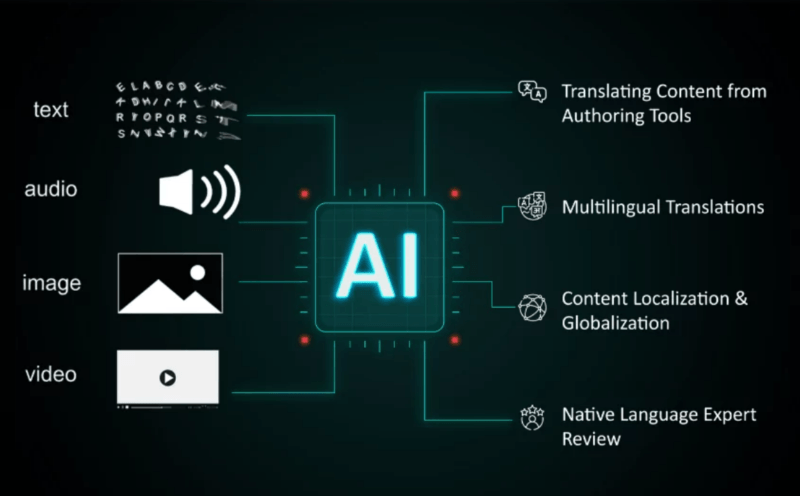
Translation tools that rely on AI technology are computer programs that use an AI to convert written or spoken text into another language. By combining machine learning, deep learning, and natural language processing approaches, these translators figure out the hidden patterns of the text and render translations.
The old translation methods mainly used a dictionary and a set of grammar rules. Current generation systems are capable of reading through an entire sentence to find words that will suitably convey the translated message of the whole sentence.
Imagine the scenario where one company has to translate a product page from English to Spanish. Rather than a person laboriously putting each section’s heading, the description, and even the instructions into Spanish, the people in a team can use an AI-based tool to have translation done within a matter of seconds.
For companies that consistently communicate with global customers, suppliers, employees, and partners, these language tools can be quite helpful.
Familiar uses involve translating business communications, adapting websites for local audiences, developing multilingual support materials, translating product descriptions, and comprehending complaints or suggestions from the customers that are handwritten in different languages.
Still, it’s not the case that translations produced by AI are always correct and require no reviewing. Their excellence will vary depending on the language combination, the topic, the set of training data and how complex is the original text.
How Does AI Translation Work?
AI translation is a mix of technologies that are deployed by the machine to recognize language and to produce text in a target language. Even though the actual procedure is quite technical, it can be broken down into a few simple steps that most businesses should find easy to grasp.
1. Analyzing the Original Text
The translation system starts by reading and studying the input text to detect language markers. Words are not the only element taken into consideration – for example, the way sentences are constructed and how punctuation is used is all part of the equation too!
To take the changing nature of words as an example, a word’s meaning is likely to be affected by the situation in which it is being used. The business version of a word could very well have a different meaning when, for, instance, the same word is used in daily conversations.
Figuring these patterns out is useful for the system to generate accurate translations.
2. Utilizing Machine Learning Models
Vast majority of contemporary translation systems depend upon neural machine translation techniques or other AI related technologies. The machines study the patterns from enormous data sets of multi-lingual texts.
The machines while being trained, understand the correspondence of the words and phrases across languages. Based on the patterns they have learned, they predict the best possible translations for future content.
In addition to that, some of the latest systems use large language models to translate not just the contents but also the instructions; they are capable of adapting the tone and style, rewriting translations for different kinds of audiences, etc.
According to Microsoft Learn’s guide to AI and large language models for translation, different translation technologies are good for different things. Neural machine translation is good for a fast translation if the task is very repetitive, whereas large language models are good for a task that needs more context or more natural sounding language.
3. Creation of the translation
The source text has now been processed and the translated version in the target language has been generated. It is up to the tools whether to give the user a direct translation, alternative words, or even tips how to make the text more readable.
Suppose a company uses a customer service message as the original that is translated into French, the version in French is a first translation, then they change the wording or phrasing for the translation to sound more polite and to match their audience.
4. Review and further enhancement
An accurate review must be the final stage. A company should take the manual review of some translations very seriously or they could also rely on the use of glossaries of approved wording or check translation against original.
In addition, this checking phase is a good idea whenever technical terms, company financial statements, product specifications, or legal requirements are used in the text.
Although, AI is able to cut the time it takes to translate documents, human oversight is the right idea here since the most important things are correct meaning and the text being clear and easy to understand.
In-Businesses AI-powered Translation Tool Favorites
Since different platforms provide different capabilities, it is not just a matter of picking up the best language translation service, but to select one that fits the needs such as company’s language capability, workflow, budget, and security concerns.
Google Translate
Google Translate is one common translator for text, short messages, daily business interactions and the likes. With it, you can understand foreign-language mail, analyze customer comments and get translated contents of websites just to mention a few.
Owing to the ease of its access and use, it is handy when employees need a fast solution or just for day-to-day interactions. Nonetheless, the company should make sure that they check the translations before letting anyone know or use as customers might not be the best judges.
Google Translate is a great choice if you have a limited budget, and you mainly translate short messages and basic content. On the flip side, since translation results may vary significantly based on the original text, it is advisable to rely on a trusted third-party service for formal documents and legal translations where accuracy is crucial.
Moreover, Google Translate doesn’t really take context and subtlety of language into account, so it can fail to catch nuances that make up the language. Finally, keep in mind that Google Translate is only one of the language translation technologies available and it’s quite probable that there are at least a few of others that you haven’t heard about or don’t make much use of that might be better tailored to your specific situation.
If your requirement involves a large amount of text or documents, then you might consider using some online machine translation (MT) tools such as DeepL. You should definitely consider these if you’re not looking for an all-in-one machine translation solution for the time-being.
DeepL Translator
DeepL, an AI translation technology, enables translating text and documents, as well as other functions for use of the professional working environment. Based on your plan and the languages that are supported, companies are even allowed to use features for customization so that their preferred terms and styles can be consistently used.
It would be a good option for companies in case they need to have natural-sounding translations of their business emails, reports, and website content.
Companies are advised to evaluate the platform’s effectiveness by using their own sector-specific documents instead of taking for granted that one application will yield the finest outcome for each and every language pair.
Microsoft Translator
Microsoft Translator not only provides written translation, but supports the translation of speech as well in various languages. It can also work as a helpful tool for organizations that require simultaneous translation of customer interactions, content, or conversations integrated in technology-based workflows.
Companies that are already leveraging Microsoft solutions, may find the ecosystem and integration options of great assistance. However, features provided will be dependent on the respective service or the plan selected.
AI Assistants and Large Language Models
Ai assistants can translate texts, as well as tailor the language, simplify the vocabulary, or change the way a message is communicated in order to suit the characteristics of the audience.
For instance, a client can ask for Spanish translation of a friendly and professional product release. It then can be asked for a layman’s version suitable for customers having limited technical understanding.
Despite these developments, general-purpose AI assistants are not as efficient as the professional tools meant for translating only one language into another. Companies planning to use the tool for daily work need to first test its terms’ accuracy, consistency, privacy controls, and language-specific performance.
Affordable Accuracy: The Power of AI Language Translation
One of the decisive factors when choosing a language translation for business purposes is how accurately it can capture the nuance and meaning of the source text.
Newer AI translation systems can generate acceptable translations for common language pairs and simple text. These may be used at work to translate routine emails, product texts, and internal documents after only a little editing work.
Still, the quality of translations can sometimes fall short depending on the type of documents being translated.
Language Pair Determines Success
The availability of different training data plays a crucial role in the development of the different languages. Therefore, the quality of translations also depends on the source of the translation, or target language.
An AI might be really good at translating between English and Spanish but could have trouble with a rather obscure language pair.
Companies marketing products or services within a region should carry out translation testing by using sample texts that match their target readers.
Sometimes Meaning Changes with Context
It is common knowledge that some words and expressions may convey different meanings depending on the situation. An online translator might generate a grammatically perfect phrase, but the intended purpose may never be grasped.
The accurate translation of idioms, jokes, references to culture, and informal language is usually a hard task.
As a matter of fact, some marketing catchphrases which are perfectly natural in English might not only be strange but also wrong if translated literally in another language.
Industry Terminology Has to Be Kept in Sight
The language within a technical industry typically contains a lot of specific and sometimes jargon terms. Such businesses, e.g., software development companies, financial institutions, medical and legal fields, may require a highly accurate translation of particular terms because they carry a very precise meaning within their respective industries only.
Having a common vocabulary is essential in making the message coherent and consistent throughout different language content, and this is why it is highly recommended to compile a dictionary of preferred terms and let professionals working on the topic be engaged in the reviewing process of critical texts.
To get an idea, a professional translation organisation such as the American Translators Association’s resource on machine translation should go through automated machine translations in situations where mistakes could have serious repercussions.
Top Advantages of AI Translation for Businesses
Getting Your Message Across Without Delay
Fast delivery is one of major perks of AI translation. Staff can translate standard messages and written material themselves which gets them out of the habit of waiting for full manual translation of each paragraph.
This allows international teams of workers to get the work done, reply to questions and keep the flow of information going with minimum time lag.
Translation Costs Cut Down
The use of AI for suitable translation tasks will lessen the volume of basic-level translations that get entrusted to certified translators.
Companies can make use of AI-generated text versions for simple correspondence and first drafts and then get the expert touch from the professionals by having them review content that needs higher accuracy level.
Nonetheless, the total cost should factor in not only the price of a software license but also the cost of integration, post-editing and quality checking.
Pleasing the Whole World of Customers
To most consumers it is just plain easier to read information that is presented in their native language.
AI translation can not only help support operatives to quickly digest and reply to inquiries coming from different areas. It also makes maintaining the multilingual version of FAQ’s and articles significantly easier.
With regard to elaborate complaints or customer problems of the type a business must handle, in some cases human review with excellent command both of native language and second/third one is probably required even after machine translation is done.
Homogeneous Multilingual Content
A business is quite often required to communicate the same set of details through the website, emails, product pages, and support documentation.
Such kind of translation services, apart from providing translation, manage terminology and even customization features, thus aiding the teams in maintaining consistent use of product names, technical terms, and preferred words across these channels.
Better Possibility of Foreign Expansion
Getting into a foreign market requires you to do a great deal beyond merely translation of your website. One has to localize the product information, change the customer support, rewrite marketing messages, and adapt documentation.
Artificial intelligence-based translation can support the teams to get content suitable for the target language in shorter time, thus increasing the chance of trying out new markets without a big investment.
It would be, however, a great idea for companies to adjust their content in order to meet the local standards rather than just literally translating every page.
Practical Business Scenarios Where Use of AI Translation Will Greatly Benefit
1. Website and Online Shop Multilingualization
With AI technology at their disposal, any online business that sells goods and services via the Web is in a position to provide their customers with translations of product details, page category, FAQ, and even instructions at checkout.
Taking a step further, an Online Retailer that wishes to penetrate the French market could decide to first translate its product catalogue and customer-related information before launching the online site.
However, the human team will still be responsible to check, verify, and edit where necessary measurements, technical data of the product, delivery details, as well as culturally appropriate expressions. In addition, it’s possible that the team will need to adjust the content of product descriptions and search terms to fit local market keywords as well.
2. Business Sales and Communication Across Borders
Typically, a sales representative is likely to deal with a buyer from abroad. AI translation can be used to help one decipher such correspondence and also to tailor messages to a buyer who prefers communication in a language different from the one the salesperson is using.
Equally, marketing staff can make use of AI to translate such content for the campaign, mailer, and even a product launch announcement to reach a wider global audience.
At the end of the day, though, the translation is not enough to make localization work. What may be a hit in one language could be a failure in another when the nuances between the two languages aren’t properly understood or translated – from style to examples, even to the ‘ask now’ of the CTA.
3. Customer Support
If a company is receiving support requests from the customers through several languages, then AI can be a huge help in understanding the messages and drafting preliminary replies,
Assume that a software company gets help request for a technical issue in German while the entire support team communicates in English only. With the use of translation tools, the latter will be able to grasp what’s wrong easily and deliver the response within a shorter time span.
As it can often be the matter of technicalities, the human agent needs to check the problem-solving steps, final answer, and complaint, if any, that have reached to the customer, before sending it.
4. Internal Team Collaboration
Different departments within a corporation or even the members of global teams may communicate through their own language, during their meetings, brainstorming sessions, and informal talks.
Employees working on translated documents, emails, and notes can be a big help in collaboration through the aid of AI translators. Some software may include voice translation and/or note-taking features that could be a great advantage for multilingual meetings if the platform allows.
In the long run, this could lower the chances of getting misinterpreted as well as help the collaboration process go smoother regardless of different time zones or cultures involved.
5. Contracts and Business Documents
Foreign suppliers, customers, and co-partners sometimes send documents which the company needs to get the gist of.
It allows the staff to comprehend the main point of a document, a rough translation of it by AI.
A professional with good legal acumen should always revise such materials as the small mistake in translation can be disastrous. It may lead to a complete reversal of a duty, a change in the timing or a different condition altogether.
6. Product Documentation and Technical Content
Technology companies usually have a collection of manuals, guides, and other resources related to usage of their products, their setup, troubleshooting and support.
To be ready with the multilingual documentation quickly, companies that frequently release updates to their product can very well be helped by machine translation.
Before publishing, it is important that an expert technical person proofreads the language terms, labels on an interface, the commands, the safety notes and the sequential guide.
Drawbacks and Issues of Using AI for Translation
While AI translation offers many advantages, there are certain limitations of AI translation that companies ought to think of before trusting it as a means of communicating vital information.
Wrong Meanings and Incorrect Features
AI technology is not perfect and will sometimes generate fluent sentences that contain wrong information. A translation could seem correct but change the original meaning, forget a condition, or bring in an incorrect detail.
This issue can be a big headache when there are technical instructions, financial information, or customer commitments.
Localization – Differences in Culture and Region
Different regions use language in different ways, formality and culturally specific expressions.
For instance, a Spanish-speaking translation may not be appropriate for all Spanish speaking markets, hence the importance of cultural suitability.
Identifying the target audience and reviewing localized content with regard to cultural suitability are steps that businesses must take.
Private and Sensitive Information
If you upload internal documents to a translation service it is probable that a risk of data-handling is created, which is dependent upon the provider, the kind of account and the privacy settings.
Companies need to revisit their data retention policies, check their access controls, examine contracts, and figure out whether what clients are giving might help them better their products or services.
If the firm wants to handle things like secret deals, customers’ private messages, cash receipts, and other sensitive business information, those should be done with tools approved for that task only.
Dissimilar Terminology
Customers and staff will be puzzled if different versions of a technical term or product name are used in different languages. In such a case, one term is translated and the other remains in the original.
By employing approved glossaries, translation memories, style guides and centralized review, the businesses can minimize that risk wherever the solution is supported.
Minimized Human Judgment
Even if AI is good at identifying and reproducing language patterns, it cannot replace all aspects of human judgment. A good translator can help when humor, persuasion, cultural sensitivity or subtle emotional meaning need special attention.
That is why businesses have to select the degree of involvement by a human expert in accord with how important a piece of content is.
Best Practices for Using AI Translation Tools
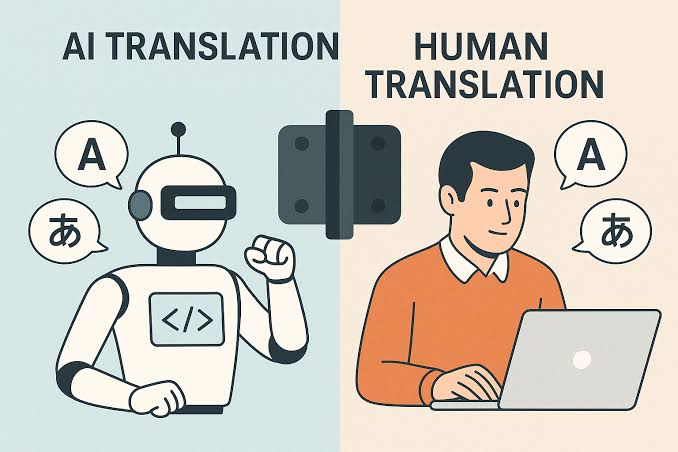
Firm grasp on how you run a business process can give you the edge if you also decide to use a combination of human translation services and AI tools.
Provide clean, well-defined input text. Keep your sentences short and simple and get rid of all the unnecessary words and jargon.
Find suitable translators or translation platforms. Do some trials and tests with real-life samples representing different areas of your business communication and languages that you use.
Create a list of preferred vocabulary and terminology. Keep track of the final wording for product names, special terms, marketing expressions and other frequent phrases.
Get human validation for tricky and risky content. Engage professional translators or in-house specialists to validate content where errors or inaccuracies could be dangerous or harmful to the company’s reputation or the end users.
Ensure secrecy of confidential matter. Choose only service providers that can guarantee the protection of your documents and understand the company’’s handling of sensitive data before entrusting them with your business records.
Monitor and evaluate the level of accuracy and fluency of the translated output to determine if the tool is worth the cost of a license or it will only cost you the total price when you hire the human team to fix the output that is generated by the AI tool.
You must update the workflow regularly and monitor translations when products, regulations, terminology, or customer expectations get the slightest changes.
Following these tips helps companies harness the power of automation without compromising the quality and dependability of their message.
The Future of AI Translation in Business Communication
Artificial Intelligence (AI) translation will probably see more frequent incorporation into business tools. The refinement of speech recognition, contextual analysis, and multilingual language models has opened up a wider communication task support capability.
Businesses can easily translate customer support messages, video conference dialogue, website content, and collaboration documents in their respective interfaces.
Customizing workflows is one area that will see significant transformation. Instead of sticking to one method for every document, companies can set up terminology guidelines for different teams, define the writing styles or formats, and create review procedures suitable for different departmental needs.
No matter how far these innovations get, the need for quality checking will not diminish. A trustworthy business translation process should ensure that you get a correct message without sacrificing your privacy, that you remain culturally neutral in the process,
Perhaps the most effective results are expected to come from combining the efficiency of AI and human skills in the most critical decision-making scenarios.
Conclusion
AI-based translation services are revolutionizing communication at companies by enabling fast and easy access to multilingual content. Such technologies allow a business to cut the effort of translation considerably and reach a far bigger audience by handling, among other things, international sales, customer support, websites localization, and internal collaboration.
Nevertheless, rapid delivery does not equate to correctness.
Different languages, industry-specific wordings, and the nuances of cultural references can affect precision of translation. Confidentiality, reliability, the risks of mistranslation, and similar aspects should, therefore, also be taken into account when using the translation services.
To design or re-organise a company’s multilingual content strategy, one needs to select the right tools, keep terminology updated and consistent, limit exposure of company-critical information, and manually review and confirm significant content, etc.
In the end, companies should perceive AI-based language translation as primarily a means for increasing productivity rather than an attempt to replace humans entirely through the power of machines.
One does not want only to have more stuff translated but the real point is helping people understand each other through languages.