
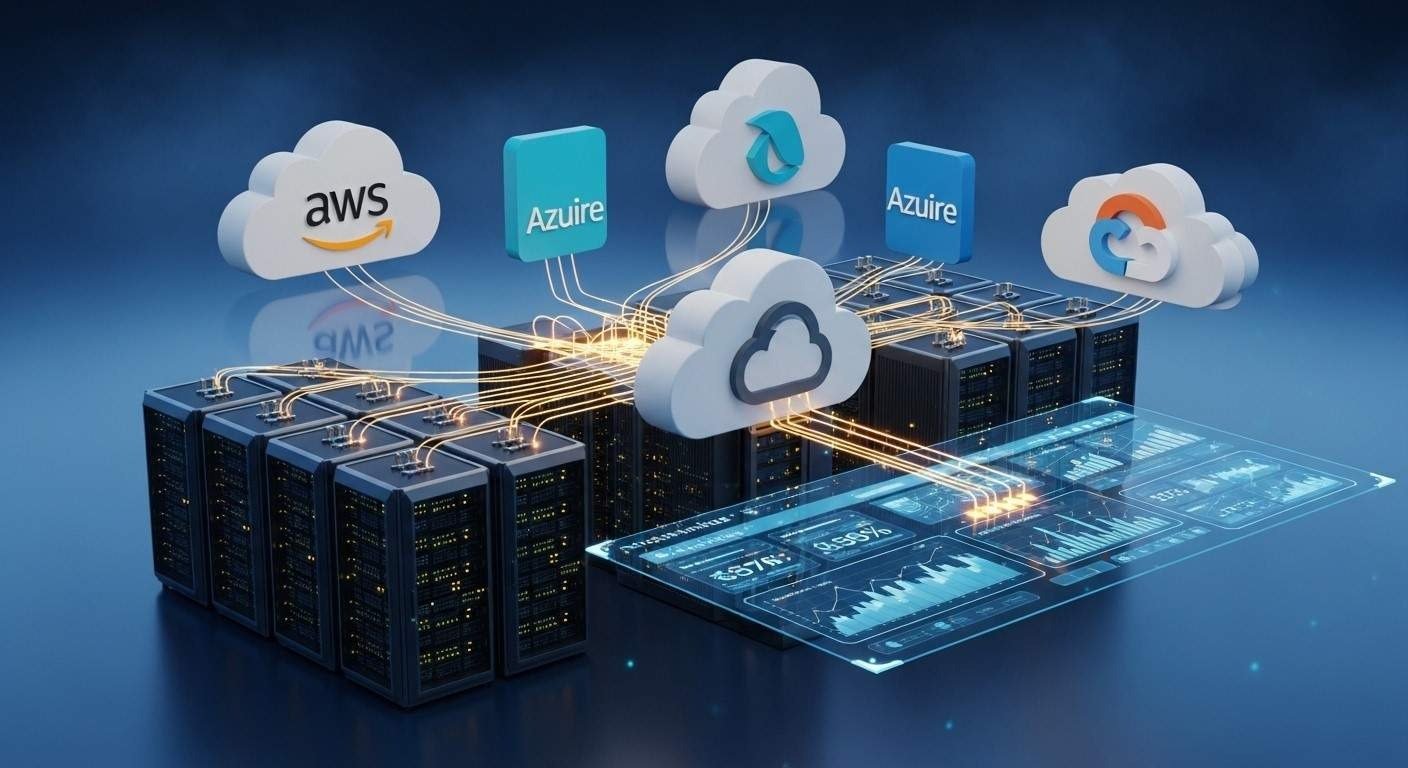
The enterprise IT landscape is evolving at an unprecedented pace, compelling organizations to rethink the way they host and deliver applications. Gartner’s latest predictions indicate that by 2027, 90% of organizations will have embraced the hybrid cloud model. This approach integrates on-premises infrastructure, private clouds, and public clouds to offer a highly flexible IT environment.
A hybrid cloud solution enables companies to enhance workload efficiency and security while managing costs. For instance, sensitive data can be handled in a private server, whereas a public cloud can be used for less critical tasks, benefiting from its capacity. Nevertheless, this flexibility inevitably results in complexity. The management of various environments entails monitoring, skilled IT teams, and the right set of tools.
This guide is aimed at highlighting the management dilemmas associated with such sophisticated environments. We will survey the leading hybrid cloud management tools of 2026 and share practical methods to support your IT team’s ongoing success.
Hybrid Cloud Management Dilemmas
Implementing a hybrid solution certainly grants greater flexibility, but it also introduces the above-mentioned complexity. Data integration across various systems remains the biggest challenge. The more locations your data resides in, the harder it becomes to have one single view that serves all. It is no surprise that managing applications and their performance becomes a headache for IT departments.

Security and compliance are other major challenges when the data is transferred between private and public clouds. Data is most vulnerable when it is on the move, and organizations must implement robust encryption procedures. Keeping public network threat awareness can be a useful step in developing hybrid environments’ security.
In addition, budget overruns are a major challenge yet again. In fact, some enterprises end up spending 35% more on their cloud than what has been allocated. This usually happens due to idle resources, duplicated storage, and inefficient workload distribution.
What Should Be Included in Hybrid Cloud Management Tools?
In order to cope with this growing complexity, enterprises must invest in hybrid cloud management tools that could serve as a command center and offer comprehensive visibility. The leading hybrid cloud management tools come equipped with a unified dashboard for effortlessly managing AWS, Azure, Google Cloud, and on-premises servers.
Besides, another primary functionality of automation and orchestration is your IT staff being able to conduct resource provisioning and scaling automatically, triggered by current demand in real-time, instead of setting up the servers manually. This not only minimizes human mistakes but also significantly accelerates time-to-market.
Moreover, a high level of FinOps and cost management feature availability is a must. Today’s hybrid cloud tools provide detailed reports that enable users to track, analyze, and optimize their expenditure effectively. In terms of security and governance, these tools usually come with pre-configured company policy templates that allow safe deployments.
Top Hybrid Cloud Management Tools in the Market
Selecting a platform that fits your business is entirely dependent on your requirements. Here we have compiled a list of some of the leading solutions that are making a difference in the hybrid IT space:
Sedai
Sedai is a clear highlight in the autonomous operations and AI-assisted cost control space. Instead of merely signaling to users, it performs changes autonomously for cost savings in complex environments, simultaneously achieving resource utilization optimization with very little human intervention.
Holori
Holori’s powerful features include infrastructure mapping and multi-cloud cost visibility. It can produce very precise representations of your cloud stack, thus making it easy to identify where your money goes and how various components are interconnected.
CloudHealth by VMware
CloudHealth enjoys strong support in the cloud policy management and multi-cloud governance domains. Large enterprises are able to use it for setting up strict financial and operational limits so that no team can overspend or deploy unapproved resources.
Morpheus Data
Morpheus Data comes with the best hybrid orchestration and self-service provisioning features. It grants developers the ability to quickly launch their self-approved environments, thereby eliminating IT-related bottlenecks and preserving stellar corporate governance.
Hybrid Cloud Strategy Building
It is necessary to lay down a comprehensive hybrid cloud blueprint even before the software is rolled out. First of all, you should understand your current set-up and decide on the objectives of the business. Will it be that you want to cut down the costs, speed up the applications, or upgrade the disaster recovery? Your knowledge of the goals will steer you to the right set of hybrid cloud management tools.
For further assistance in regard to gaining a rock-solid foundation, you are welcome to check out this AWS guide on creating a hybrid cloud strategy. Right after the plan is ready, your team should be encouraged to conduct a pilot program. Choose a small set of low-priority tasks for testing the new tool so that you have a chance to evaluate the ROI before going for the total rollout.
Multi-Cloud Management Best Practices
Managing and operating resources spread across various cloud platforms efficiently demands strict adherence to processes. It is important to underscore the importance of having well-defined policies and user roles, along with a centralized identity and access management (IAM) system. Every single user should only get access to the exact resources that are necessary for task accomplishment.
You also need to focus on optimizing workload placement. You might, for example, want to keep latency-sensitive workloads on private clouds or on-premises servers while probably making use of a private IP address for secure, localized routing. Public clouds can, on the other hand, handle scalable, high-traffic applications pretty well. Appropriately positioning these workloads not only simplifies multi-cloud management but also significantly enhances user experience.
The Next Generation of Cloud Optimization Tools
The trajectory of enterprise IT will largely depend on the adoption of new technologies. We are experiencing a big transition here: from simply providing visibility to offering autonomous, real-time remediation. Leaders must actively track and integrate these new strategies into their multi-cloud management plans if they want to stay ahead, as was also mentioned in a recent Gartner strategic report.
Currently, AI and machine learning significantly contribute to the anticipation of capacity needs and automation of FinOps. The modern hybrid cloud management tools don’t stick to only analyzing the bills of the past; they forecast usage fluctuations and accordingly adjust resources. Hence, these sophisticated cloud optimization tools are destined to continue reshaping the way enterprises function, completely lifting off the manual infrastructure management burden.
Become a Pro in Handling Your Hybrid Cloud Infrastructure
The enterprise networks becoming complex call for the use of advanced hybrid cloud management tools, which, apart from enabling cost control, data security, and improvement of operational agility, also have manual oversight that is simply not feasible anymore.
Working with hybrid and multi-cloud environments is not an optional upgrade; it is a vital business step for staying competitive. Assessing your current cloud infrastructure is the decision that you will thank yourself for in the future. Take this opportunity to figure out your biggest pain points, and good luck with your demo of one of the top hybrid cloud management tools that will show you how automated IT operations can be.
FAQs
What is a hybrid cloud environment?
A hybrid cloud environment is an information technology setup that connects on-premises servers, private clouds, and public clouds into one cohesive system.
Why do enterprises overspend on cloud resources?
Common factors leading to overspending include a high number of idle resources, a lack of insight into usage, and errors during manual provisioning.
What is the main benefit of hybrid cloud management tools?
The key value proposition is that users get a single-pane-of-glass experience for visibility, cost control, and automation of resource orchestration.
How does AI help in cloud management?
AI is capable of predicting resource requirements, performing cost-saving actions, and discovering security loopholes in a matter of seconds.
Should I use a pilot program before buying a cloud tool?
Definitely, running the tool on a small number of workloads first will give you a clear boundary and measurement of ROI before full deployment.
