As companies are entering global markets, communicating with customers from different language environments, and distributing content for the whole world, to maintain that communication they need accurate and clearly written translations to the intended customer or group of customers of the company. However, picking the right way of translating is a tough decision.
With translation done by AI you can rapidly turn a huge volume of content into another language. These tools can aid businesses in translating their mails web pages, product information, and customer support correspondence without using too much time and money. But human professional translators offer not only a deep understanding of language but also culture and that kind of thing which is not available in such automatic systems.
Faster and cheaper the service, the lesser value one can expect, so the only thing that counts are quality, privacy, and other cultural factors that the wrong translation would bring into your marketing and branding. That is why businesses ought to take these points into account as well as speed and price when deciding between the two types of translations.
The differences between AI translation and human translation, their pros and cons, and tips for businesses on selecting the proper method for respective situations are covered in this article.
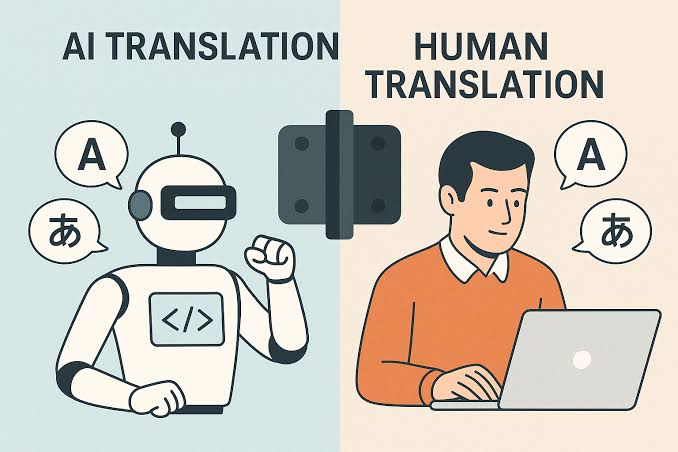
Difference between AI Translation and Human translation
Human translation is the process of translating a source document from the language of the author or speaker into a target language which the intended reader or listener understands. The translation process is usually a two-way interaction between the speaker/sender and the listener/receiver. The translator is the third party which mediates the communication between the two parties.
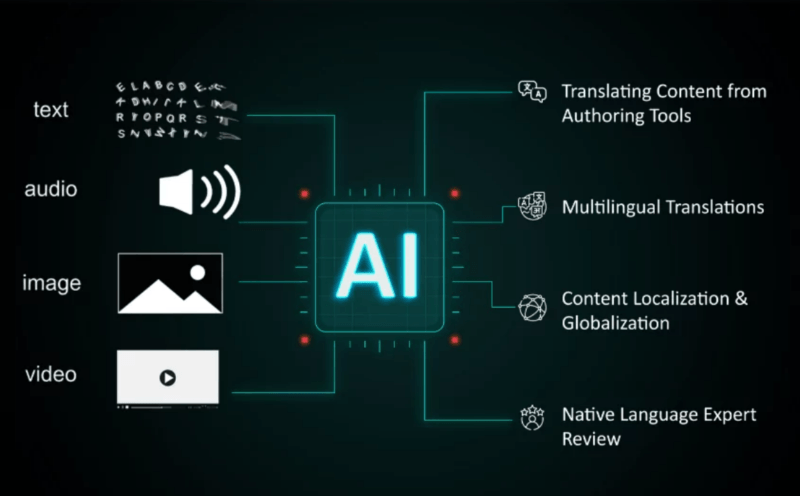
In contrast to human translation, AI translation refers to the utilization of a combination of artificial intelligence and machine translation technology to convert the source language text into the target language text automatically. In other words, these translation system are designed to work without human intervention to do the translation for them.
In addition, AI translation systems learn language patterns and utilize that knowledge through processing the huge amounts of texts to provide translations.
Many translation tools today can actually parse whole sentences and look beyond the current word for some context information. These are the reasons why such tools are handy when it comes to translating common commercial language, web pages, product descriptions, and internal documents.
As a use case, when a software corporation wants to target the European market, they might rely on AI to translate product descriptions and user manuals. Rather than manually translating page by page, they can get a rough translation of everything at once, check it for any errors, and then upload the translated version.
AI-based translation services are particularly handy tools for businesses that require a vast amount of relatively uncomplex content to be processed.
Yet that does not mean that the use of AI to generate text is fool-proof. A translated work could still be comprehensible in human language but carry subtle errors in the meaning, vocabulary or tone. Businesses are therefore strongly advised to carefully weigh the significance of the paper involved and then determine whether automated translation alone is good enough.
What’s Human Translation?
A human translation refers to translating written text from one language to another with the aid of a person who is a master in both languages, and also has enough knowledge about the specific subject of the original text.
Professional human translators will focus on aspects like grammar, meaning, context, tone, the needs and expectations of the reader, and differences in culture.
Besides, human translators can pinpoint issues in the source text that make it ambiguous, and by raising doubts the translator makes sure that both parties reach at least an understanding of the final translation that is acceptable.
A company wishing to run a marketing campaign targeting customers fromJapan may require their professional translator to do more than merely translate the English version of their advertisements. A human translator will not only adjust the wording but the message itself and ensure that the language used sounds native to people in Japan.
Lawyers usually advise clients to go with human translations for highly sensitive documents, such as contracts, patents, or any other document that might cause harm in case of an error.
It’s also a commonly used solution in the financial world – human translators are the best choice for things like audited financial reports or tax returns. Moreover, when it comes to messaging customers or the public through different languages about a product launch or major update, companies usually rely on professional translators since even a slight mistranslation could damage the audience.
It goes without saying that human translation is usually a longer and more expensive process compared to machine translation. Nonetheless, the professional review of such a translation is often the key factor that allows companies to eliminate any potential miscommunication and maintain their professional brand across different markets.
In a nutshell, while both AI and human translation have their place and can be instrumental in facilitating international business communication, the ways they operate and the suitability to different tasks distinguish them from each other quite clearly.
AI vs Human Translation: The Main Issues
Human translators and computers are both capable of translating, yet they do so in completely different ways, and for different purposes.
1. Translation Speed
One major advantage AI translation offers is fast turnaround times. For instance, machines are capable of handling huge volumes of texts at light speed, which makes them incredibly efficient for companies that have big websites, elaborate product guides,
Lets say you have an internet shop that needs to show your products to different markets using different languages. AI can generate initial translations at scale, which means a human review is still needed but the overall translation work can proceed at a much faster pace.
So while a computer program is excellent at rapidly handling large amounts of language material and even producing a good first translation for a product, the final proofreading may only be done by the human being who has a professional eye to detail.
This is why sometimes the decision of the business whether they hire human translators or use machine tools is a very important matter when it can impact their business communication or brand image.
In general, human translation takes more time as human translators first need to digest the source material, come up with the best fit wording, double-check terms, and finally proofread the resulting text.
Nonetheless, the time spent on delivering a translation also depends heavily on the language pair, subject matter, word count, and the desired quality level.
That is to say, a very short text can be translated quickly by a professional while a complex technical document may need more time in the researcher and reviewer phase, to cite but one example.
So, which one is preferable? AI translation may well be an option for time-saving reasons and bulk content processing. Human translation is preferred where a document needs precise interpretation, where a subject matter is highly specialized, or where a text calls for some type of creative expression.
2. Cost of Translation
AI translation may be a good budget-saving strategy for corporate translation projects that involve mass production of repetitive content. Some free tools, others subscription-based or pay-per-use.
Human translators are paid for their work based on a variety of factors including, but not limited to, length/word count, language pair, subject complexity, turnaround time, and editing needs. That said, the cost of specialized legal, medical, or technical translation is often higher because these types of translation demand an extra level of knowledge and skill which is not commonly found.
But initial savings may not be the full picture either. If a translation error occurs in an article generated by a machine, companies might be forced to pay for the correction, customer assistance, redesign and maybe even legal support.
As a rule, a wrong answer to a small internal question is not very critical. On the other hand, incorrect instructions about product safety or terms of a contract might lead to very serious problems.
Businesses should look into the whole cost of having content made reliably, not only the translation production part.
Whose turn is it? AI cuts down a lot of routine, translation cost, and massive volumes translation. Whereas professional translation service might just be a better investment to do the job that demands accuracy and accountability.
3. AI Translation Accuracy
AI translations accuracy can vary greatly and is usually a balance of a number of factors like the languages being translated between, the topic, the writing style, the usage of terminology, and the context made available to the system.
Translation of common languages, and sentences being in plain language may be helpful. But technical vocabulary, vague expressions, phrases, and special terminology may interfere and bring down AI translations’ quality.
Consider a sentence that comprises a term capable of several different meanings, for example, and it may be incorrectly translated if the system runs out of context to work with. The output may look fine grammatically, but it could still leave out a vital condition or even totally change the original message.
Manually trained human translators are able to scan through the document for clues to spot ambiguities and figure out which possible meaning suits the context. They also look at numbers, terms, and all the minor details, which in combination might alter the interpretation.
However, human translators will not be right every time. Translators may commit errors, be at a loss about the specifics, or miss the slightest inconsistencies. Their performance will be affected by their level of knowledge, the availability of the background information, and their work environment or procedures like checking.
In order to minimize errors, businesses have to implement a thorough quality assurance procedure. Major translations most probably involve terminology verification, proofing, double-review, or subject matter consultation.
A detailed document on machine translation of The American Translators Association’s guide to machine translation to be carefully checked and that professional help should still be part of many business applications.
4. Language Culture and the Interpretation of Local Culture (4)
In fact, it means more than just a dictionary translation to switch word in language and understand the language. Besides vocabulary, humor, tone, cultural references, local idioms, and the expectations of an audience play an important role in communication.
In spite of the fact that AI tools can deliver decent translations, they are not always capable of capturing the nuances of the culture or the meaning that is very much dependent on the local context.
For example, imagine a company which aims to translate an English advertising slogan into another language. If done literally, it might be grammatically correct, but it could be awkward or even offensive to the local customers to read it.
The use of a professional translator, who knows the target market well, can result in a successful translation in the spirit of the original without sacrificing it completely. The localization is a process which allows for changing the content so that it fits local tastes and customs perfectly.
Some important aspects to be considered while doing translation are culture adaptation as it refers to the translation that is suitable for the particular context of a culture. It is more of a change that is driven by one’s understanding of the culture and the expectations it sets:
- Advertising campaigns and brand messaging.
- Website headlines and landing pages.
- Humor, idioms, and creative content.
Product names and slogans
Customer-facing emails and support messages.
For companies expanding into new markets, natural language in their communications can greatly affect a company’s brand reputation with customers.
A translation that is well done but also appropriate in its local language may be the perfect way to get people to feel more like they trust a brand. On the other hand, if a text is very strange or not really appropriate for the target language, a reader can take this as an indication of the lack of attention a brand company has towards its own audience.
Which one is good? When the goal is to communicate across cultures (as in marketing or sales), to convince (as in a persuasive business or legal text), to be expressive (as in literary writing or design), or to build a good business reputation, one has to go for human.
5. Confidential Documents and Data Privacy
Confidentiality is yet another important matter to compare between AI vs human translation.
Sensitive documents such as customer addresses, personal info of employees, business plans of products, financial reports etc are often worked up by businesses.
Uploading such data to the internet for a machine translation service may raise a question of breach of privacy and non-compliance issues. Also the different translators have different policies of treating the input data.
A part of the companies offer text storage option for the material they translate, whereas some others allow the customer to decide if, for how long, and how the company’s privacy policies should be implemented. In any event, companies should not have the misconception that an inexpensive website tool gives the same level of confidentiality for the company’s documents as needed.
Before a company decides to use AI translation service for their confidential data they ought to go through the service provider’s privacy policy, how long the data is kept, who has access controls, what level of securities are there and also the contracts. They should also be in compliance with laws and other regulations.
To some extent human translators can provide confidentiality agreements and also have processes of handling sensitive information which are proven. Nonetheless, simply hiring a human translator does not ensure a secure result.
If the information is already public it might not be of much problem to translate an internal product announcement but if it is still under the wraps of an acquisition agreement or the confidential customer database is what you are translating it definitely needs more attention and precautions.
What is it that really counts? The best choice is that there needs to be a very well designed set of security measures, the fact is that it should be neither humans nor AI that perform the translation. For confidential documents, use an approved and secure process, rather than relying on third parties for the translation.
6. Consistency in Business Content Translation
It’s quite common that organizations have to work consistently for all platforms, such as websites, product interfaces, support materials, and publicity.
An AI-powered translator is a good way to ensure a consistent message if it gets all the terminology right and uses the language memory. Also, it is good for getting repetitive jobs done.
Man-made translators can understand corporate policies and figure out when to leave the word intact as well. They spot inconsistencies which automatic mechanisms can overlook in the case of a word with different meanings in different contexts.
In short, you take the example where a software house uses a special phrase about one of the functions throughout its product UI and explanatory materials. If that line is translated separately and with a different meaning in different parts of the site it might bewilder the people.
A blend of AI and a human element makes it possible for companies to stay on message at the same time as getting the job done quickly.
Business Applications for AI Translation
Using AI to translate a text is a great alternative in cases when the text is non-critical and minor mistakes in translation may not matter much. In such scenarios, where translation needs to be carried out quickly and efficiently, with large volumes of translation, and cost is a prime factor, AI translation could be the way to go.
You can consider this type of translation for these main purposes:
- You get familiar with emails or other written pieces coming in in a different language.
- You generate quick translations of internal messages.
- Product information that needs to be translated in large quantities can be routinely translated by AI.
- Help articles and FAQs can be written first via AI and then revised.
- Reading reviews and feedback about your products to have a rough idea.
- Professional editing of the first draft.
We can imagine that a software as a service startup (SaaS) company that provides its support and troubleshooting pages in many language versions, they could use the AI translation service to translate these content. A linguist working at the company, for example, could look at the major content pages or sections and approve them before the translations go public through the international site.
Such a strategy could allow the teams to move at a faster pace while recognizing that not everything that comes out is fully polished and ready to go.
When Are Human Translation Services Necessary?
In such scenarios professional human translators have a significant role to play, particularly when a wrong translation might lead to serious consequences in legal field, financial decisions, personal safety issues, or harm to a business’s image.
There are several times when a company might want to turn to expert human translators:
Legal and Contractual Documents
Legal documents such as contracts, agreements, documents from the court system, compliance materials and official records may often include precise words that carry legal repercussions. A little mistake in translation may lead to misunderstanding about an obligation, exception or condition.
Such documents ought to be translated by qualified translators who have a background of legal expertise, with further legal proofreading where required.
Medical and Safety Information
Directions for the use of drugs, patient details, caution warnings and emergency action guidelines demand special attention. Mistakes here can result in administering the wrong dose, warning or instruction to a person and could put their lives at risk.
The materials mentioned should be translated and scrutinized by suitably qualified experts in line with the relevant standards and rules.
Financial and Regulatory Documents
Accounts, tax returns, investing brochures and regulatory disclosures frequently include both highly technical language and exact numbers. It would pay a business to have such documents verified by an independent professional in case a mistake had been made which could alter a decision or lead to a breach of requirements.
Marketing and Brand Content
Persuasion techniques and cultural references are frequently embedded in advertisements, product promotions, taglines, and website landing pages. A seasoned translator or a localization expert will be able to convey the spirit of those messages to a new audience by means of culturally relevant wording and a local flavor, rather than the literal translation of sentences.
Customer-Facing Business Communication
If something went wrong, if you have bad news, if someone on the corporate team talks to you, or if, say, you are the recipient of an important notice from your customers, tone management is absolutely essential. It is the human factor that can guarantee that the message is perceived as it’s meant to be, without hurting anyone’s feelings or creating a mess by being obscure.
The right kind of proofreading is determined by the character of the content, the level of seriousness, and, above all, what the target market demands.
Is It Better to Use a Combo of Human and Machine Translating?
To most companies, the wisest approach is not choosing between the two methods only but mixing AI’s speed with the insight of a human translator.
The process is generally called post-editing or AI-assisted translation by humans. The computer does the bulk of the work, i.e., it translates a passage automatically and quickly in the beginning; and afterward, a specialist translates, checks, and improves the translation so that it is fit for use in the business or publication context.
A business can follow these steps:
- Prepare the source content. Be sure the initial text is clear, precise, and doesn’t have unnecessary ambiguity.
- Select the right tool. Think about the target language, area of expertise, security rules, and what terminology controls are available.
- Create the translation. Deploy AI for the right type of text, and keep a copy of the source document for later comparison.
- Go through the translation. Hire someone with experience of the target language and ask them to check not only if the language matches the original content, but also that the grammatical, tone, and terminology aspects are appropriate.
- Lay special attention to important details. Ensure that names, figures, dates, references to web pages, technical descriptions and legal/safety wording are correctly conveyed.
- Have the final version approved prior to publishing. It should be of a level that satisfies the company’s and confidentiality expectations.
Not every document calls for the same degree of vetting. An internal company note may require only a quick inspection, whereas a contract or a notice that is about public safety will probably need the input from a professional translator and a formal validation.
A great tip is to pick the type of translation technique according to the level of risk the content carries and the reason it needs translation.
Mistakes That YourCompany Should Prevent
YourCompany will most definitely benefit from your translation activity when you know which errors to get away from.
Printing AI-generated translations without human review: Smoothly-flowing text may not mean that there is correspondence in the original message.
Selecting a translator based only on their price rate: Cheapest translation costs may be not even cheap at all if one makes you suffer extra expenses by way of error or even the loss of trust by customers.
Disregard for the differences in culture: It is possible that the meaning of a directly translated text will not reach different readers although their grammatical construction is correct.
Uploading confidential data without reviewing the privacy policies on the platform: To avoid any possible leaks and breaches, Companies should make sure their service providers have strict data safeguard and confidentiality policies in place and be ready to meet those requirements.
Limited availability when dealing with generalists: It is important to note that documents such as legal, medical, financial, and technical materials may be better served with the help of translators who are also experts in the field.
Avoiding translation mistakes can greatly help businesses evaluate the quality of translation, translation efficiency, and risk assessment.
How to Choose the Right Translation Method?
Before deciding on a translation method, there is a list of practical questions that businesses might need to ask:
- To what extent does this document need to be absolutely accurate?
- Can an error result in legal, financial, safety, or reputational problems?
- Will the content need to be culturally adapted or have a specific brand voice?
- Does the document have any classified or personal details?
- How much is there of content to be translated, and how fast the translation is required?
- Is there a trained reviewer who can be assigned to the end product to review it?
In case of a document that’s a regular one with low risks and a huge volume, maybe a use of AI can be a good starting option. However, if the document is a risky material, something which is legally important, creative, or which will be used as a decision-maker’s input, professional translation services with a reviewer are mostly considered to be a safer bet.
Many companies rely on a hybrid approach – automated translation technologies, expert linguists, and clear quality benchmarks as the most effective combination.
Conclusion
Thanks to AI translation solutions communication across languages for businesses has become not only faster but more affordable as well. They can significantly cut down the time it takes to handle bulk quantities of the same content on a day-to-day basis, besides helping them communicate with global customers more efficiently.
At the same time, we should bear in mind that just the speed and cheap price of AI don’t automatically equate to the accuracy of the result. Cultural nuances may be lost, misunderstandings may occur in ambiguous situations, or the AI might come up with a translation so smooth and correct that we will not even suspect it being wrong until it is too late.
In such cases, human translators are the ones who possess the needed contextual awareness, expertise, and critical thinking to produce correct translations especially when the matter at issue is complex or sensitive in nature.
In determining whether AI or human translation is the preferred option, businesses need to consider the use case of the content, repercussions of a mistake, and the required level of quality. Machine translation is handy for translations of everyday material and creating a first draft whereas only professional human translations should be used wherever the accuracy is vital, e.g. in medical, judicial, finance, and creative sectors as well as those where confidentiality is an issue.
For an overwhelming number of companies, the most effective way is to deploy AI whenever it gives a definite advantage and to engage expert human reviewers whenever correctness, confidentiality, or cultural comprehension are of utmost significance.