

Introduction:
Website owners have long held the belief that the more keywords they insert into their content, the higher they will rank on Google. However, the situation is different nowadays. In fact, more than 90% of all websites that are on the web never reach Page 1, even though virtually all of them are using keywords in one way or another.
What’s the reason?
Because Google doesn’t reward keyword stuffing anymore. Search algorithms have been improved, people’s search behaviors have changed, and the internet has become a very competitive market. Now, it’s not just about the keywords – it’s about Search Engine Positioning SEO as well.
Search Engine Positioning SEO is a way of getting your website higher up in the search results by taking into account factors such as user behavior, intent, CTR, authority, and overall experience.
The result of that is:
Better positioning → More clicks → Higher engagement → More conversions → Long-term market leadership.
SEO vs. Search Engine Positioning: Understanding the Difference
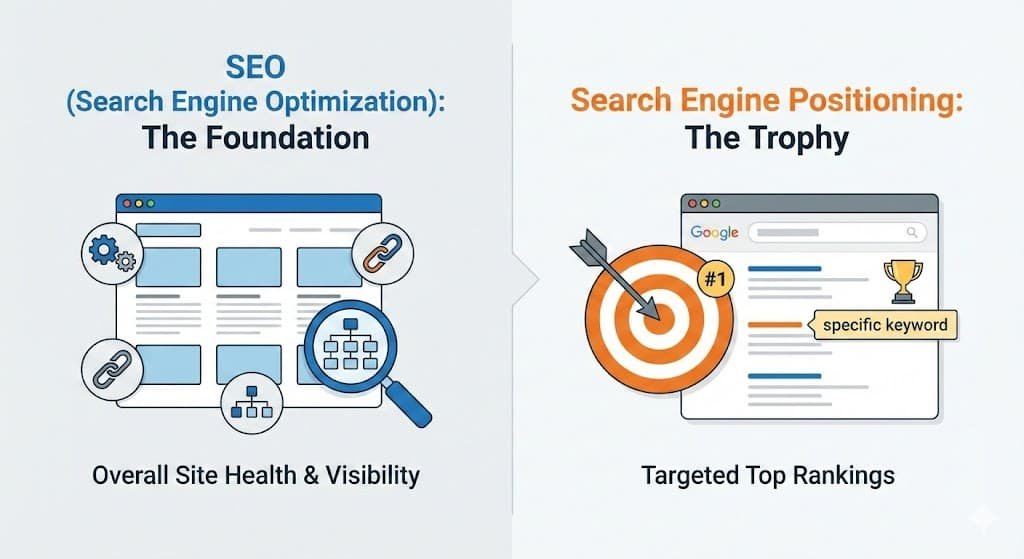
While they are related, SEO and Search Engine Positioning have different objectives.
SEO (The Base)
SEO emphasizes the work that needs to be done on the site so that the search engines can understand the content and the context.
SEO work involves:
- Keyword research and optimization
- On-page SEO
- Backlink building
- Site structure
- Technical improvements
SEO without a doubt is necessary, but it is just the starting point.
Search Engine Positioning (The Strategy)
Search Engine Positioning SEO refers to the actual work of getting your website to the best possible place in the search engine results pages (SERPs).
You can think of it as the boost that helps your site appear in:
- The first 3 spot of the results
- Featured snippets
- People Also Ask (PAA) section
- Rich snippets
- Local map pack
Simplified Illustration
Imagine SEO as getting the right paperwork done to open a shop inside a mall. Meanwhile, securing a spot right at the entrance of that mall is Search Engine Positioning.
Simply put, more visibility leads to more customers.
CTR Optimization — An Expert in the Art of Getting Clicks
Your website’s CTR (Click-Through Rate) is a very important factor Google takes into account when determining your ranking. Surprisingly, even if your page is the first result, it can fall down the list if the CTR is very low.
Why Users Click: Stimuli to the Emotions
The reasons why users click can be explained by the following emotions:
- Curiosity
- Urgency
- Benefit
- Fear of missing out
Here are some examples of effective headline templates:
- “The Secret Strategy Behind Fast Rankings”
- “Stop Wasting Time on Keywords—Do This Instead!”
Power Words Usage
The deliberate use of powerful words not only helps clarify the message but also increases the chances of a click:
- Proven
- Free
- Secret
- Ultimate
- Fast
- Warning
- Guaranteed
Meta Descriptions Are also Mini Sales Pitches
What your meta description should do is:
- Highlight the user’s problem
- Show what benefit your page offers
- Use emotional language
- End with a call-to-action
Example:
“Learn about the proven technique that enables websites to rank high on SERPs without overusing keywords. Enhance your ranking now.”
Rich Snippets & Schema Markup
Schema is a great way of differentiating your page through:
- Ratings
- FAQs
- Stars
- Product details
- Events
- How-to steps
This results in an increase of both the visibility and the click-through rate.
Understanding User Intent — The Psychology Behind Search
Google has evolved from being just a simple search engine. It has now become an Answer Engine.
It is no longer primarily concerned with the number of keywords, but rather with finding the content that is most relevant to the user’s intent.
Four Types of User Intent
- Informational: “What is Search Engine Positioning SEO?”
- Navigational: “Ahrefs login”
- Commercial: “Top SEO tools for 2026”
- Transactional: “Purchase web hosting”
When content matches the user’s intent, both the ranking and the user satisfaction go up.
Align Content With Intent
- Informational → Guides, how-to content
- Commercial → Comparisons, pros & cons
- Transactional → Reviews, CTAs, offers
- Video intent → Tutorials, demonstrations
Authority & Trust — The E-E-A-T Framework
If you want to be on the first page of search results, Google has to trust you. This trust can be won by following the guidelines of E-E-A-T:
1. Experience
One can provide real-life examples, deep insights, screenshots, and personal results as well. Google in particular, highly values the content that is based on unique experiences and supported with evidence.
2. Expertise
Decide on a particular field and become a source of reliable and comprehensive information on that topic. Writing more articles on the topic will make Google recognize your expertise more.
3. Authoritativeness
Authoritativeness can be developed through various channels,
such as:
- High-quality backlinks
- Brand mentions
- Collaborations
- Guest posts
- Press coverage
4. Trustworthiness
People want to visit trustworthy websites, and so does Google. There are ways to build trust that include:
- HTTPS
- Clear About page
- Privacy policy
- Proper fact-checking
- No misleading claims
Advanced Strategy: Topical Authority & Content Clusters
Topical authority is just one of the many things that Google relies on to figure out that you are the best source for the topic in question.
Pillar Pages
A “complete guide” can be focused on one major topic. For instance: “Complete Guide to Search Engine Positioning SEO”.
Cluster Content
Write a handful of supporting pieces from the main topic perspective:
- CTR optimization
- SERP psychology
- Core Web Vitals
- Ranking signals
- User intent
Smart Internal Linking
Each place in the cluster should connect to the pillar page, which results in various benefits for Google:
- It makes crawling your site easier
- Better understanding of the relationships between different topics
- Highlighting the most important pages
Case Study: The Coffee Shop Comparison
Scenario A: The Struggling Shop (Keyword-Focused Only)
The cafe website had a focus on keywords like:
- “Best coffee near me”
- “Freshly brewed coffee”
At the same time, their:
- CTR was very low
- There were no reviews
- Schema markup was absent
- Local SEO was weak
They never got to the first page of Google, instead, they were on the 2nd or 3rd.
Scenario B: The Dominator (Positioning-Focused)
This other cafe made use of:
- Effective headlines
- Content tailored to local intent
- Google My Business optimization
- Positive customer reviews
- Site with fast load speeds
- Schema markup
Result: They were in the Top 3 and their:
- Traffic was tripled
- In-store sales doubled
Lesson: Search Engine Positioning SEO is an absolute winner over keyword stuffing.
Technical Factors Affecting Search Engine Positioning SEO
Technical performance plays an essential role.
Core Web Vitals
Google evaluates:
- LCP: How fast the page loads
- CLS: How stable the layout is
- FID: How quickly users can interact
Slow and unstable pages lose ranking quickly.
Mobile-First Indexing
Google currently prioritizes indexing the mobile version of your website. Therefore, if your mobile version is subpar, your ranking is bound to drop.
Common Mistakes to Avoid
Keyword Cannibalization
Google gets confused when a website publishes multiple pages targeting the same keyword. As a result, both articles lose their ranking.
Ignoring Analytics
Data tells you where to go next. Without the use of the following tools:
…it becomes like trying to find your way in the dark, and your ranking does not go up as fast as it should.
FAQs
1. What is Search Engine Positioning?
Search Engine Positioning SEO is a tactic that aims at increasing a website’s search results’ visibility by incorporating user intent, CTR optimization, authority building, and technical performance besides the use of keywords only.
2. How is Search Engine Positioning different from SEO?
SEO is about laying the groundwork of your website whereas Search Engine Positioning is concentrating on achieving the best ranking positions, featured snippets, and overall attainment of the SERP visibility.
3. How do I improve Search Engine Positioning?
Make use of attractive titles, work on CTR, develop user intent-based content, acquire authority, optimize Core Web Vitals, and establish internal link clusters supporting your main topics.
4. Why is Search Engine Positioning SEO important in 2026?
The reason why 2026 is important for Search Engine Positioning SEO is that with AI-driven search (SGE), Google highly considers attributes such as experience, intent, trust, and the depth of the content. Positioning is your ticket to staying visible and having a competitive edge in this new era.
5. Is keyword stuffing still useful for ranking?
Definitely not. What keyword stuffing does is, it deteriorates your ranking instead of enhancing it. The main search engines nowadays are looking for naturally written content, well-structured pages, semantically related keywords, and experiences shared.
Conclusion: The Future of Search (AI + SGE)
Search Engine Positioning SEO is the next stage of SEO. Google is increasingly being AI-driven, which also means a better understanding of the SGE (Search Generative Experience). The mere use of keywords will thus be incapable of attracting the desired traffic.
Where you will find the difference is in:
- CTR
- Intent matching
- Authority
- Trust
- Technical performance
- Experience-based content
If you are able to get a grip on Search Engine Positioning SEO, then your website will not only obtain a high ranking – it will become the dominator of your niche.
Why not start right now: Check your titles, meta descriptions, speed, schema, and internal links. You would be surprised how much your ranking and organic traffic can be boosted by small changes.
