
Let’s suppose the CEO drops you a very urgent, personal Slack message at 8:00 PM one evening: “I’m in a meeting that is very important. There is a vendor who has to be paid $15,000 very quickly, I need to give authorization through an invoice but I don′t have time. Can you be so good as to process the payment right away? The invoice is attached.”
A very hardworking staff member who is already under pressure and wants to please their supervisor would instantly comply to this request. Just within a short while everything’s done and over with, only for the person later discovering that the CEO has never actually sent the Slack message.
This type of scenario is not an example of an actual hacking method. It is, rather, an illustration of psychological manipulation.
The change from a closely-knit small startup team to a big rapidly growing company naturally results in stronger computer defenses but at the same time, human defenses become very shaky. We’ll look into human-based cyber attacks (which are quite different and very effective) by examining in detail the underlying psychology in those attacks and figuring out why exactly scaling teams are most vulnerable targets, plus, of course, suggesting what the company can do to guard itself against these kinds of breaches.
What is Social Engineering? (The Art of Human Hacking)
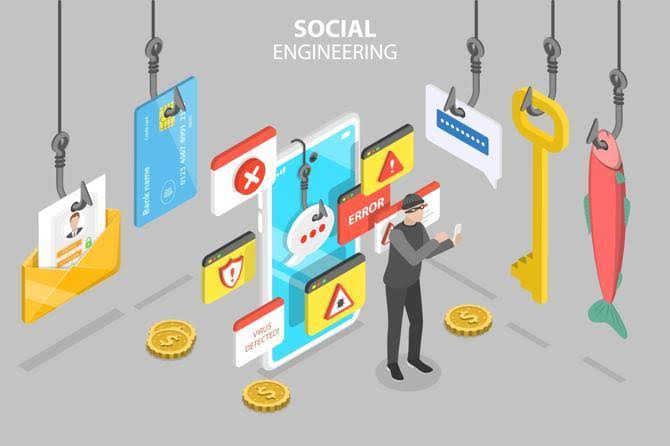
When we talk about social engineering in relation to cyber security, what we are referring to primarily is the use of human psychological manipulation in order to make the victim either expose some information or make a mistake from a security perspective.
Ordinary cyber attacks depend on vulnerabilities that might exist in a codebase of the software while social engineering attacks go in a different direction – they take advantage of people’s natural weaknesses such as trust, fear, interest or the urge to be helpful.
[Identify the Target] ➔ [Do Some Recon] ➔ [Establish Bond/Get the person to like/trust you] ➔ [Leverage Emotional State (Fear, Urgency)] ➔ [Attack and extract whatever is possible from target]
A latest cybersecurity threat report showed that over 90% of all breaches where an actual insider was involved were initiated via a form of social engineering. It is enough that one person’s account is exploited to gain access to confidential databases, customer records, or financial accounts, and all a company’s expansion is likely to be stopped in a blink of an eye.
Why Cybercriminals Target Scaling Startups Mostly
Cybercriminals seldom go for launching a super-complex malware against a hyper-growth startup, but instead, they do their homework on the organizational transformations which unfold when a company grows.
This is the reason why human manipulation is so effective in scaling company teams:
1. The Erosion of Familiarity
There came a time when, for a company, an employee knowing everyone personally was not only possible but also common. However, as a team expands from a couple of people into several dozen, the level of mutual familiarity decreases. Fresh hires join, vendors and contractors come on board and work for the company every week. By posing as a new hire or an executive, the attackers play on this very gap knowing that even the most discerning employee is unlikely to challenge a person or a name they don’t recognize.
2. Stressful and Fast Work Culture
The goal in a growing company is speed. Employees are constantly under pressure of having deadlines, closing sales deals, or getting customers on board. Under that cognitive burden (which is also mentally exhausting), people tend to rely on fast, “System 1” judgments (based on emotions and intuition) instead of slow, “System 2” reasoning that is based on logic and analysis. Attackers, on their end, know this weakness and, with their attacks, try to take advantage of this very speed-induced state.
3. Poor or Nonexistent Communication Channels
In their early days, small companies commonly use different communication apps almost interchangeably – for example, sending financial details or sensitive data request via Slack can be followed an hour later with a WhatsApp or email or, worse still, through iMessage. In the absence of clear regulations and/or guidelines on the channels through which official communication must take place, the employees don’t stand a chance in distinguishing between a perfectly genuine emergency and a highly sophisticated phishing attempt.
The 6 Psychological Triggers Weaponized in Cyber Attacks
To build an effective phishing prevention system, you must first understand the six primary cognitive biases that attackers leverage to bypass an employee’s rational judgment.
| Psychological Trigger | How Attackers Use It | Real-World Example |
| Authority | Impersonating high-level executives, legal teams, or tax authorities to command immediate obedience. | An email appearing to come from the “Internal Revenue Service (IRS)” demanding a tax audit review. |
| Urgency | Creating a false time limit to bypass logical analysis and force quick action. | “Your account will be permanently suspended within 2 hours if you do not verify your login details.” |
| Scarcity | Offering exclusive access, early perks, or limited-time bonuses to trigger curiosity and FOMO (Fear Of Missing Out). | “Click here to claim your spot in our exclusive early stock option allocation scheme.” |
| Trust / Liking | Building rapid rapport or leveraging the name of a trusted brand or mutual connection. | “Hey, I worked with Sarah on your marketing team last week. She suggested I send you this link.” |
| Social Proof | Convincing the victim that “everyone else is doing it” to make a risky action seem safe and standard. | “The rest of the engineering team has already updated their portals via this external dashboard.” |
| Reciprocity | Providing a small favor or free resource to make the victim feel obligated to help in return. | A fake customer service agent helping solve a minor tech issue, then asking for credentials as a “formality.” |
Types of Social Engineering Attacks That Most Often Affect Expanding Teams
1. Spear Phishing and Whaling
A common phishing method is to spam the list of thousands of people with the same message which is why these ones are not the targeted phishing type (they can be considered as more generalized).
- With whaling attacks, the attacker’s focus is always on the top executive, founder, CEO, finance controllers or the like which is why the phishing level is so much higher. It is a type of fishing in an open sea with the use of a bait that is so big and attractive that only the big fish will take the bait.
2. Business Email Compromise (BEC)
In the case of BEC attacks, first, hackers compromise legitimate company accounts using credential stuffing and then spoof domains to look almost identical (for example, ceo@softerlnsight.com using only lowercase).
Once they’ve done that, they’ll insert themselves into real invoice emails so that payments will be transferred to the fraudsters’ bank accounts.
3. Baiting and Quid Pro Quo Attacks, etc.
The attackers are offering a temptation (either physical or electronic) that the victims will fall into the trap. This can be anything: a USB labeled “Executive Salary Review,” an attractive but malicious PDF such as “Q3 Competitor Strategy Analysis,” all in the same shared drive, a malicious file hidden as your boss’ calendar, even the temptation of free WiFi, a USB stick, etc., or, for example, giving an employee a free drink and later asking them to log onto a malicious site.
How you protect Your Team: 4 Steps Human Defense Strategy
It’s not wise to rely purely on technology as it is not sufficient for the elimination of social engineering attacks either. A comprehensive human security awareness strategy for your startup must be the focus.
Step 1: Create “Out-of-Band” Policies Verification
You have the simplest way of preventing impersonation with the enforcement of out-of-band (OOB) verification rule.
OOB Policy: In order to be safe, each financial transaction or a change of credentials or the export of highly sensitive data must first be verified through an independent channel (such as an e-mail).
If something urgent, say, an invoice payment, comes with an e-mail, the employee will have to get in touch with the requester via phone or ask them in person.
Step 2: Make “No Blame” Reporting of Incidents the Norm
For hackers to get what they want, employees being afraid and not talking about their mistakes to the relevant party is an invaluable aid to them. The main concern is that after someone has mistakenly clicked on a suspicious link, they are more likely to keep the secret as they don’t want to get the sack. That, on top of hiding such a mistake by being quiet, gives hackers ample time to move from one system to another.
Make an environment out of “a fearless reporting” so that employees don’t feel that they will be blamed if they report a mistake. For example, if someone clicks on a suspicious link by mistake, the longer IT takes to know about the problem, the less time there may be to isolate the device from the network and limit the spreading of malware.
Step 3: Do Phishing Simulations Which Your Team Would Think Are Real and Would Make It Fun
We are all quite aware of this: a powerpoint presentation on security issues will not make people change their behavior one bit. So, a better idea would be to use modern, automated phishing simulators, which are also fun, and send emails to your team that look exactly like those from real attackers with a non-punitive tone.
- Suppose that an employee, when faced with a simulation of an actual phishing email, has “fallen for it”: redirect the employee to a short and interactive one-minute learning tip.
- It’s possible to keep track of the percentage of failure rates over a period of time to single out such departments as HR or Finance that may need more concentrated training.
Step 4: Communicate More Effectively
Have a standardized way of carrying out internal work.
- You have the entire company to agree on and abide by a unified password manager (this is the best practice of all).
- Set the use of hardware-based Multi-Factor Authentication (MFA) or authenticator apps that fully remove the insecure SMS-based MFA.
- Flag all incoming messages that are obviously coming from outside your company by configuring email banners to include a warning [EXTERNAL] tag.
Conclusion: Cultivating a Robust Human Firewall
While you are at the stage of scaling, don’t forget to increase security measures. Your primary shield will be advanced firewalls, AI detection at endpoints etc., that work in the background and you, as CEO, will be protected. However, your human element is the ultimate gatekeeper of your assets and it is this element you should focus on to secure.
You can make a security system so strong that even hackers can’t see through it to your data, assets and money, but if the very human aspect is your vulnerable point, it won’t really matter.
By empowering workers to detect social engineering attempts and by setting up verification policies for them, and finally by establishing a culture that gives space for free flow of ideas, the people risk turns into defense risk.
In fact, it would not be so wrong a strategy if founders of fast-growing companies were to integrate and prioritize digital threats protection from early on in setting up the company as the latter might be one of the most chaotic and insecure phases of business.
Frequently Asked Questions (FAQS)
What is the most common type of social engineering?
Phishing, especially through email (spear phishing), is probably the number one. The method is based on faking communications from your colleagues, service suppliers, and platforms you trust to steal your accounts credentials or malware.
Why is the workforce the focus of such attacks rather than databases?
It is simply so much easier to get people’s cooperation by appealing to their basic emotions than it is to crack the very high standards of software encryption. It is common among companies to refer to the personnel as the “the weakest human security link” because they are easily manipulative with the help of social engineering.
Can a person be protected from social engineering by antivirus software?
It’s only partly. The function of antivirus software is detecting known malware and keeping malicious websites away. But, it cannot prevent human from seeing a spoofed email as a genuine one and thus getting convinced. Moreover, it is very difficult to prevent a man from being led by his emotions and deciding to perform a banking transfer manually.
What should an employee do when they get the feeling that they are being socially engineered?
The very least they should do is avoid any further communication with the person from this email address. Obviously, the first priority is the safety of sensitive information so a staff member should never click any of the provided links or open the attachment. They have to immediately alert their internal IT or cyber security department for help and confirm a person’s identify through an other channel such as phone calling that they both agree on in advance.
